
1. Overview
"One cannot die as a Hmong without the qeej and the proper funeral." — Pao Saykao, Hmong ritual specialist [4]
Academic and cultural accounts often describe the Hmong funeral as one of the community's most elaborate and important ceremonies. It is a carefully orchestrated rite whose purpose, in the traditions described by these sources, is to guide the soul of the deceased toward the ancestors — including by retracing places connected with the person's life and returning to the birthplace. Some accounts connect this journey with rebirth or reincarnation. [1][2][4]
Traditional Hmong religious life is commonly described as animist, but Hmong communities also include Christians and people whose practices have changed or combined over time. The cited research describes interaction between physical and spiritual worlds, while emphasizing that beliefs and end‑of‑life practices vary among Hmong families. Falk describes the funeral as affirming clan and lineage membership and joining past, present, and future generations. [3][4]
2. Hmong Funeral Banner Services
If your family is planning a personalized Hmong funeral banner, the providers below offer banner design and printing services. Availability, design options, timing, and terms change, so confirm the details directly with each provider. [7][8][11]
Hmong Banners
Website: hmongbanners.com — a dedicated personalized Hmong funeral-banner service with a guided design process, multiple design options, and a customer gallery. Explore personalized designs [7]
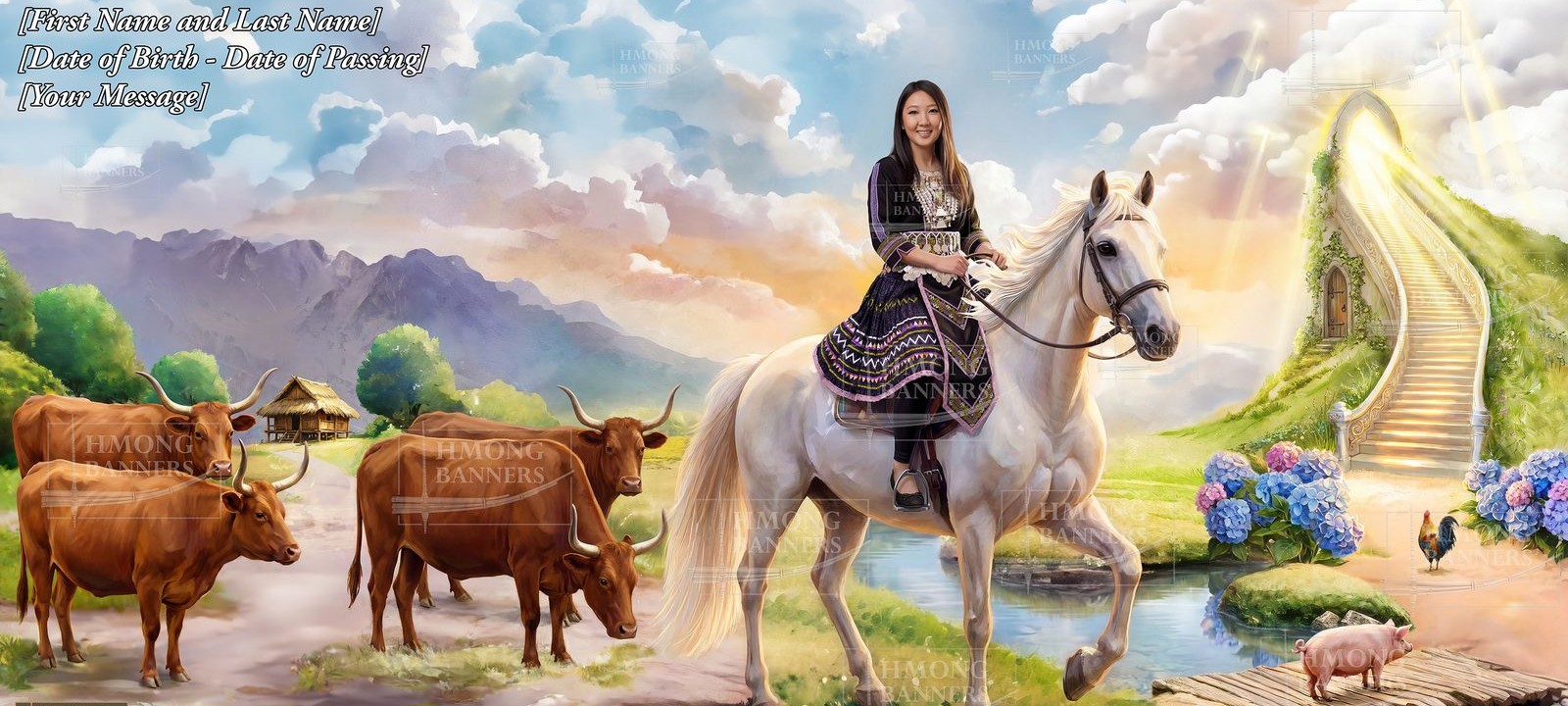
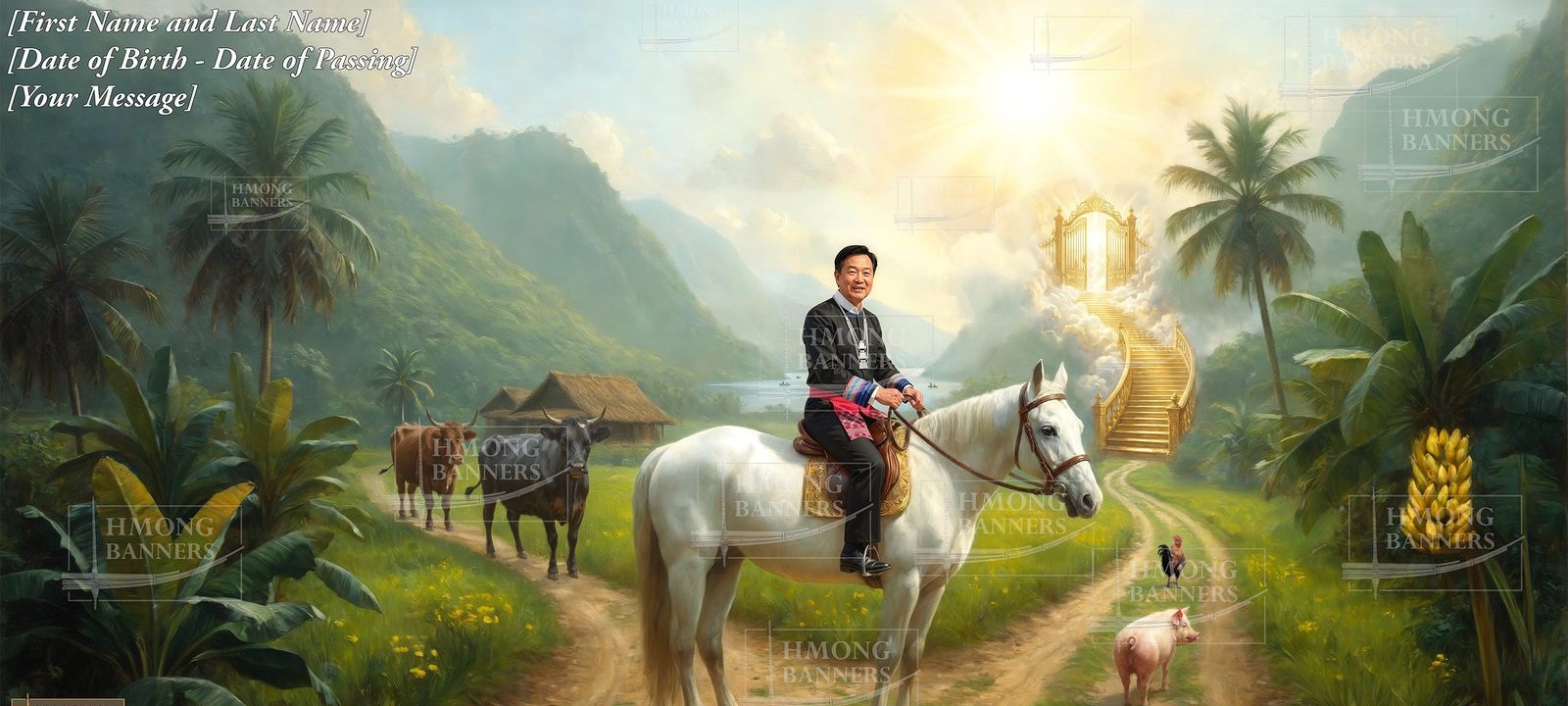
Also offering Hmong funeral banners
- Etsy — Hmint & Green Paper Studio: personalized Hmong funeral banners, with a loved one edited into a chosen design and printed on vinyl. View the listing [8]
- Facebook — Travis Vang: an independent designer who has publicly described handling Hmong funeral-banner orders, including design, printing, and shipping. View the public post [11]
For product examples and fuller details, see the Hmong Funeral Banners — Resource Guide.
3. Photo Field Notes
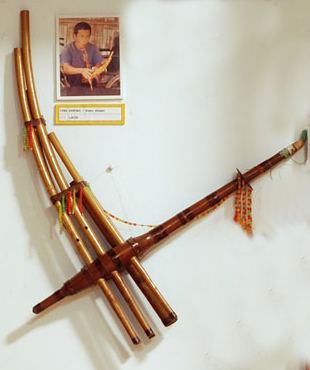
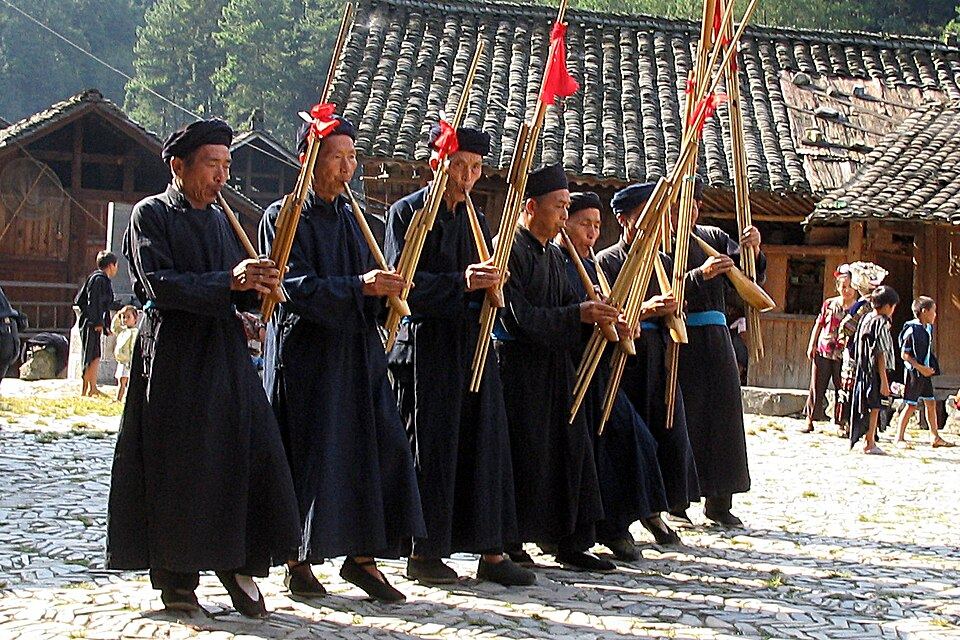
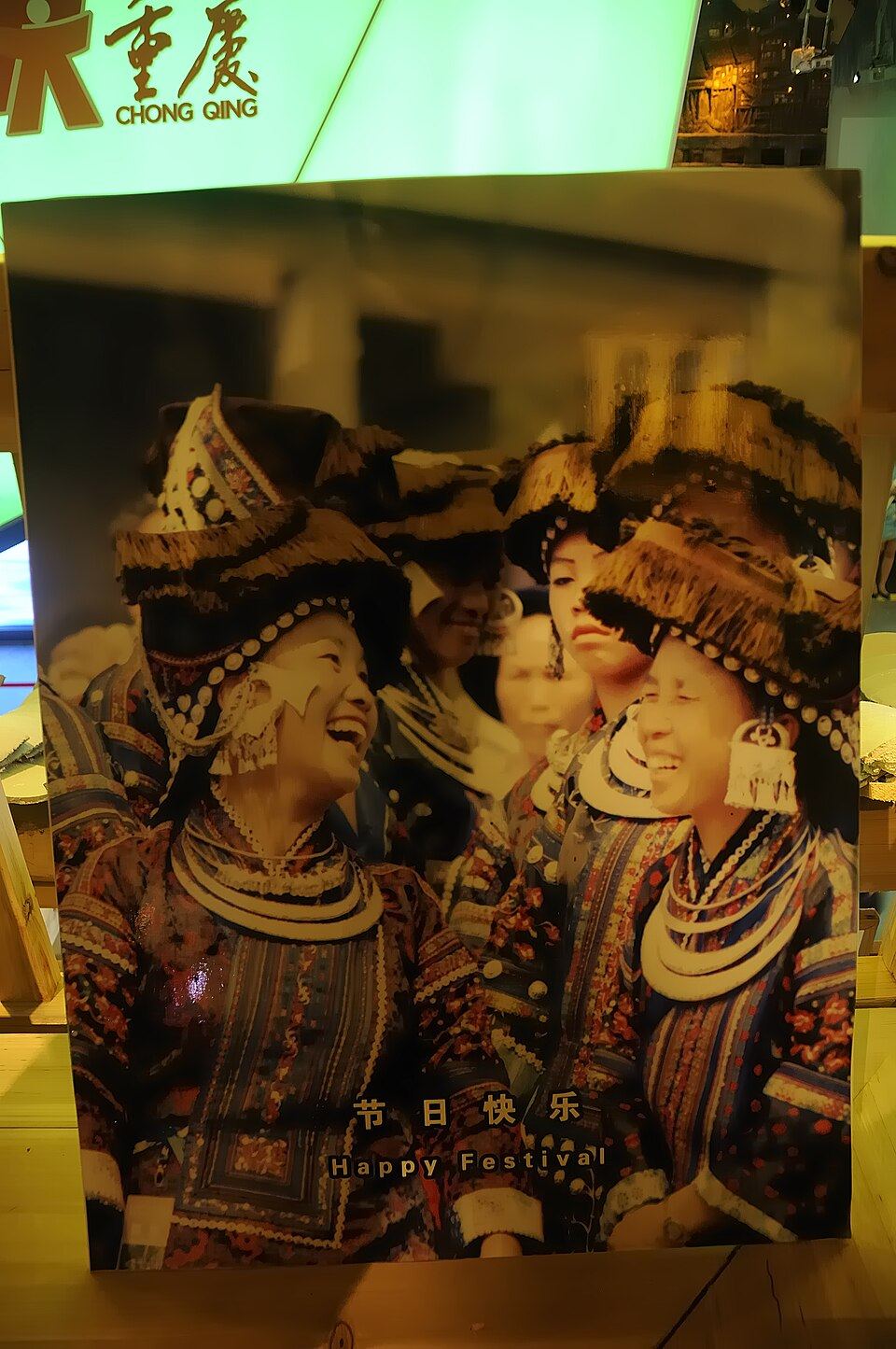
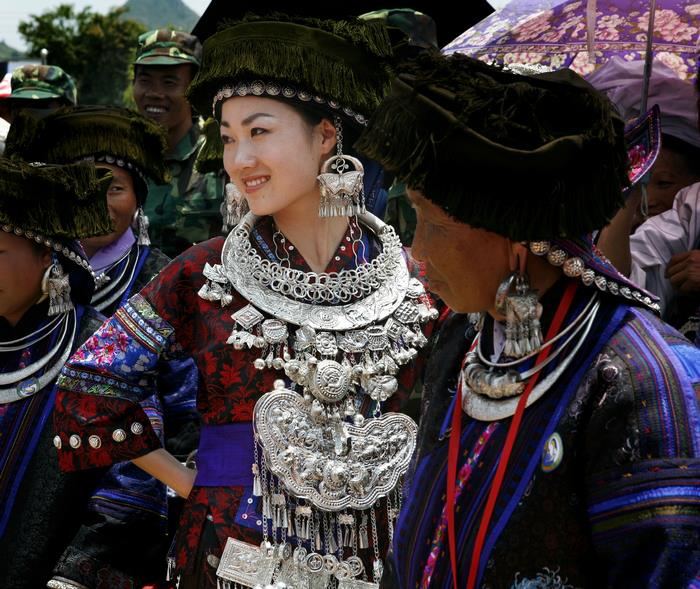
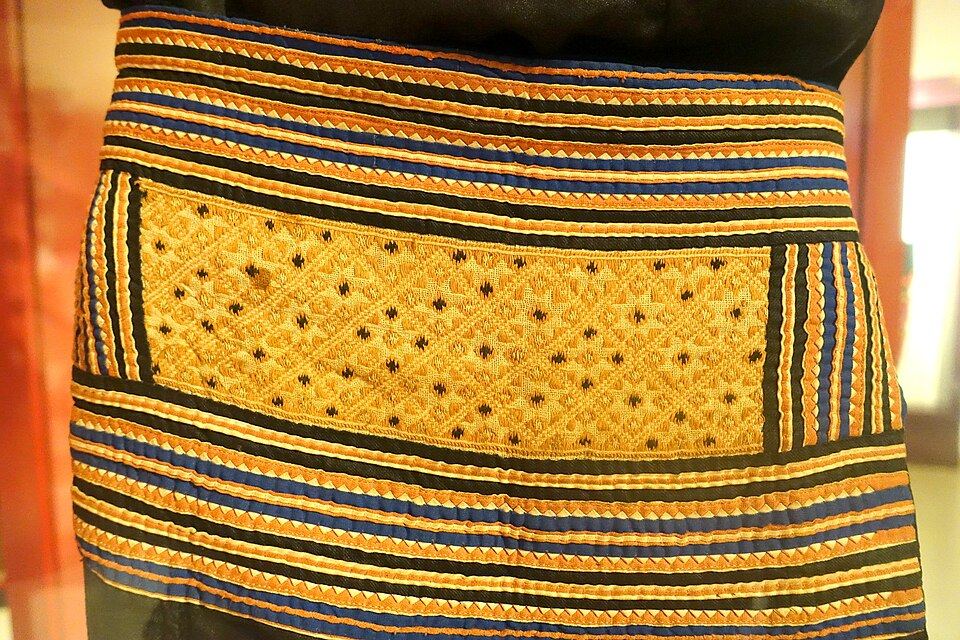
The photographs below document a qeej, musicians, clothing, jewelry, a museum-held textile, and a regional landscape. They provide visual context without representing a single funeral or one universal Hmong tradition.






4. Core Beliefs
| Belief | Detail |
|---|---|
| Multiple Souls | The 2018 review states that a person is believed to have multiple souls in the traditional accounts it summarizes. It does not establish one universal number or arrangement for all Hmong communities. [3] |
| Journey Home | One documented funeral account says the soul visits places connected with the person's life, with the final destination being the birthplace, before continuing toward the ancestors. [1][2] |
| Reincarnation | Some traditional accounts connect the funeral journey with rebirth, including the possibility of returning to the same family. These beliefs are not shared in the same way by every Hmong religious community. [2][3] |
| The Placenta | Carleton's cultural account explains that the placenta is traditionally buried under the house where a child was born, linking the birthplace with the soul's return journey. [1] |
| House Altar | In interviews with Hmong elders in Wisconsin, some Animist respondents described an altar in the elder's or oldest son's home as the place where the deceased elder's soul resides and protects living descendants. [3] |
| Different accounts | Beliefs about illness, death, the soul, and the afterlife differ by religion, family, region, and adaptation in the United States. The sources should be read as documented accounts, not as a single universal rule. [3][4] |
A 2018 review cites a 2006 estimate that about 70% of Hmong in the United States practiced animism at that time; it should not be read as a current census or a universal description. In the review's interview study of 20 Hmong elders in Wisconsin, Animist and Christian participants both emphasized family care, while Animist participants discussed shamanic rituals and Christian participants discussed prayer. [3]
5. Duration & Structure
- Carleton describes a typical traditional funeral as lasting three days and nights, with family members remaining at the funeral and comforting one another. A separate first-person account documents a three-day funeral in Wisconsin. [1][10]
- Length and procedure vary across Hmong communities and families, including because of religious affiliation, location, and adaptation in the United States. [2][3]
- A further qeej-guided ceremony of separation is described as occurring thirteen days after burial; the sources do not establish one universal form for this observance. [4]
Family members may remain at the funeral site for the full duration, comforting one another. Carleton describes heart‑shaped and circular memorials made from paper money that has no use for the living but is understood in that account as valuable in the afterlife. [1]
Planning ahead: Families often arrange a personalized memorial banner before the funeral begins. If yours is considering one, Hmong Banners offers a guided design process, and the banner resource guide lists additional providers to compare.
6. Four Ritual Roles in Carleton's Account
| Role / source term | Function |
|---|---|
| Txiv Qeej (2–4 men in Carleton's account) | Players of the qeej, the free‑reed mouth organ whose funeral music carries instructions for the soul. [1][4] |
| Txiv Xaiv (soul guide / chanter) | Sings Qhuab Kev ("Showing the Way") so the soul can follow his voice through the confusing paths home. [1] |
| Funeral drummer (Carleton's page uses the form tus ntaub nruab) | Player of the large funeral drum. Falk calls the drum Nraug Nruas (“Sir Drum”) and, in the White Hmong account she documents, says it is constructed for the occasion and destroyed when the ceremony ends. [1][4] |
| Niam Ua Mov | "Women who cook" — a role associated with preparing food for the funeral. Sources describe ceremonial meals, but do not establish one universal number of women. [1][4] |
In Carleton's account, the txiv xaiv also serves as a medium: the deceased speaks through him, delivering final words that may include blessings and negative words. The family is told to keep the good and discard the bad. [1]
7. The Qeej & the Soul's Journey
The qeej (rendered roughly as “geng,” with a high-falling tone, in Falk's pronunciation note) is a six‑piped free‑reed mouth organ whose body Falk describes as wooden. It is called “Lady Qeej” (Nkauj Qeej) and is accompanied by “Sir Drum” (Nraug Nruas). In Falk's documented White Hmong account, the qeej does not merely accompany the rite—it speaks through a disguised musical language addressed to the dead and the spirit world. [4]
Three Principal Funeral Texts in Falk's Account
- Qhuab Kev ("Showing the Way") — ideally sung by a ritual expert very soon after death, guiding the soul toward the next world. [4]
- Qeej Tu Siav ("Song of Expiring Life" / "Cut‑off Breath") — played on the qeej immediately after Qhuab Kev; the detailed instructions to the soul. The dead will hear it when played even if they missed the sung version. [4]
- Txiv Taiv ("Words of the Father") — a didactic panegyric sung by kinsmen on the second night, before the corpse is taken outside. [4]
The Qeej Tu Siav — 15 Verses (Seng Thao / White Hmong version) [4]
Scholar Catherine Falk documented the complete funeral text performed by Mr. Xeem Thoj (Seng Thao), a Laotian White Hmong ritual expert. The Qeej Tu Siav consists of fifteen verses addressed to the soul:
- Oh dearly beloved, are you truly dead?
- Ntxwj Nyoog (the Lord of the Otherworld) has allowed illness and death to fall to earth.
- It is your turn to die.
- You must put on your funeral clothing.
- Your relatives will wash your face.
- Divination sticks will help show you the way.
- You must ask permission to leave from the house spirits.
- You must start your journey.
- You must pass through the threshold.
- You must put on your shoes of hemp.
- You must choose the Hmong road to the world of the ancestors.
- Ntxwj Nyoog's guardians will greet you.
- A rooster will crow.
- A chicken will guide you to your ancestors' world.
- The Qeej and the drum will leave you now.
After the second night, Falk describes further qeej songs accompanying stages such as raising the corpse onto the bier, livestock sacrifice, burning incense and symbolic paper money, departure from the family home, and taking leave at the gravesite. The qeej also plays at a separation ceremony thirteen days after burial and sometimes again one year later. These sequences differ across the Green and White Hmong accounts compared in the article. [4]
A separate U.S.‑based account reconstructed by P. N. Thao from interviews with Minnesota elders describes the Qeej Tu Siav as containing nine sections; Falk presents this as a different structural account from Seng Thao's fifteen-verse White Hmong version. [4]
8. Hu Plig — The Soul‑Calling Ritual
Hu Plig (“calling the soul”) is described in the cited accounts as a healing or protective ceremony performed when a person's soul is believed to have wandered away—frightened, sad, or lonely—and illness is understood spiritually. A community-authored account also describes it for someone returning from far travel and, in one family example, for welcoming a new bride into her husband's spiritual clan. It is included here as related soul-calling context, not as a funeral rite. Its form and purpose can vary by family and community. [5][6]
Steps of the Ritual [5]
- The shaman stands at the front door with the txiab neeb (hooped rattle) and kuam (divination horns), two live chickens, and an egg in a rice bowl with incense.
- She chants in Hmong while rattling the rattle and knocking both sides of the door — calling the soul home and diagnosing what is wrong spiritually.
- She negotiates with the spirit world using the kuam, tossing the horns to read the answer: both flat sides down = the spirit is bound and may be raised; one up/one down = more bargaining needed; both up = both worlds are pleased and the soul can be raised.
- In part two, the same motions are repeated with cooked chicken and a cooked egg to complete the sacrificial soul‑calling.
- Family and guests then call the person's name. The Carleton account records this wording for an infant: "(Name), come home. This is where you belong… We all love you and you belong here."
- The shaman divines success by examining the chicken's feet and tongue.
- Finally, white strings are tied to the person (signifying good luck and wealth), and a tray of goodies is shared so guests also receive a portion of fortune. [5]
9. Pre‑Burial, Burial & After
Pre‑Burial Rituals
- Dressing — Falk and Davy document funeral clothing as part of the deceased's preparation. Clothing choices and their meanings vary across communities, religions, and families. [2][4][10]
- Food, drink, incense, livestock, and symbolic paper money — Falk describes these as offerings and ritual elements in the funeral accounts she compares. [2][4]
- Music and mourning — the qeej, drum, ritual songs, and women's laments appear at different stages of the funeral accounts. The order is not identical in every regional or dialect-group account. [2][4][10]
Burial Day
- Moving to the cemetery: Falk describes qeej songs for raising the corpse onto a bier, leaving the family home, and taking leave at the gravesite. Davy's Wisconsin account records a final-day procession to the cemetery. [2][4][10]
- Paper spirit money and divination: Davy records paper spirit money being burned before the cemetery procession and divination sticks being used at the grave in that funeral. These are documented examples, not a universal checklist. [10]
- After burial: Falk documents a further ceremony separating the living from the dead thirteen days after burial; the details and timing of other post-burial practices vary. [4]
10. Mourning Customs & Modern Life
| Practice | Meaning |
|---|---|
| Nyiav (open wailing) | Carleton's account says family members are required to make the sounds of crying, even without tears, as a sign of respect for the deceased. [1] |
| Txiv xaiv as medium | In Carleton's account, relatives hear final words from the deceased through the txiv xaiv and are told to keep the good and discard the bad. [1] |
| Paper money burned | Carleton and Falk describe symbolic paper money being burned or offered for the deceased's journey and the afterlife. [1][4] |
| 13‑day ceremony | Falk describes a further qeej-guided separation ceremony thirteen days after burial. Its precise form is not universal across the accounts she compares. [4] |
Adaptations in the U.S.
- Hospice communication: The cited article summarizes a case in which direct “letting go” language distressed a patient's family and notes literature describing metaphorical ways of discussing death. Clinicians should ask each person and family how they prefer to discuss dying. [3]
- Decision‑making: Some Animist elders interviewed described family, male elders, or clan leaders as important participants; the same study also documents Christian and individual adaptations. It should not be treated as a rule for every Hmong person. [3]
- Home death: Some interviewees expressed a preference for dying at home, with the reasons differing between Animist and Christian participants. Practical circumstances can require hospice, nursing, or hospital care. [3]
- Organ donation: The article documents one case in which a family believed donation could impair the soul's transition. Donation preferences should be discussed individually rather than inferred from ethnicity. [3]
- Life insurance: Some interviewees described life insurance as a U.S. adaptation for protecting family finances, replacing older forms of financial preparation such as livestock or savings. [3]
- Qeej preservation: MPR News reported on Hmong Cultural Center classes in St. Paul teaching funeral songs to help sustain knowledge across generations. [9]
12. Sources & Further Reading
- Carleton College, Religions in Minnesota. Hmong Traditional Funerals. religionsmn.carleton.edu
- Falk, C. (1996). Upon Meeting the Ancestors: The Hmong Funeral Ritual in Asia and Australia. Hmong Studies Journal, 1(1). journal issue page · PDF
- Her‑Xiong, Y. & Schroepfer, T. (2018). Walking in Two Worlds: Hmong End‑of‑Life Beliefs & Rituals. J Soc Work End Life Palliat Care, 14(4), 291–314. PMC6386587
- Falk, C. (2004). Hmong Instructions to the Dead: What the Mouth Organ Qeej Says (Part One). Asian Folklore Studies, 63, 1–29. asianethnology.org · PDF
- Carleton College, Religions in Minnesota. Hu Plig: The Soul Calling Ritual. religionsmn.carleton.edu
- Vang, P. (2014). 5 Traditional Hmong Ceremonies You Need to Know. Being Hmong American. pcvang19.wordpress.com
- Hmong Banners. hmongbanners.com · Get a Personalized Banner · Customer Gallery
- Hmint & Green Paper Studio / HmintandGreenPS. Traditional Hmong Funeral Banners: A Journey Through a Life Lived. Etsy listing. etsy.com
- MPR News. (2013). Preserving a tradition that prepares Hmong souls for eternity. mprnews.org
- Davy, J. (1997). Por Thao's Funeral. Hmong Studies Journal, 2(1). journal issue page · PDF
- Travis Vang. (2022, November 3). Public Facebook post describing PED Hmong funeral-banner orders, including idea, design, printing, and shipping. facebook.com
This page is an educational summary compiled from the cited public sources. It is not a substitute for guidance from Hmong elders, ritual specialists, or community organizations. Funeral practices vary by clan, region, and individual family tradition.